

I wrote down a set of wealth principles years ago. Reading them now, most of them are the kind of advice you get from someone who has not thought about it very hard. Save more. Buy assets. Compound. All true, all useless, because none of it explains where the assets came from or why anyone wanted them.
Here is what I think now. Wealth is not found. It is engineered, and the engineering has three parts: supply and demand, which is just economics; cartels, which is the historical record of people doing this on purpose; and game theory, which explains why cartels hold together and why they fall apart.
Wealth moves when you create demand for something you already control. Some things arrive with demand attached. Oil, Bitcoin. You do not have to convince anyone. Other things, equity in a company nobody has heard of, have no demand at all, and your actual job is manufacturing it. That is most of what I do for a living, and it took me an embarrassingly long time to notice.
Before any of that, though….
What is Money? Humanity’s Biggest Illusion
Money is a medium of exchange, a store of value, and a unit of account. A Currency is the thing you use to communicate how much of it you have, which is not the same.
Money shows up in a lot of forms:
Financial assets, meaning cash, stocks, bonds, funds, Bitcoin.
Real assets, meaning property, land, metals.
Personal property, meaning cars, art, whatever you collect.
And ownership of businesses, mostly equity.
The dimension people skip is liquidity: how fast you can turn one form into another without eating a loss on the way.
High liquidity means you can sell near market price today.
Low liquidity means it takes time, effort, or a haircut.
A lot of people who look wealthy are wealthy in the second kind and cannot do anything about it this quarter.
Keep that distinction in mind, because most of what follows is about people who controlled an illiquid thing and then engineered the market that made it liquid at a price they chose.
History of Wealth Generation & Cartels
Now to understand how wealth is generated. Cartels.
Throughout history, cartels whether legal, corporate, decentralized, or criminal have demonstrated a consistent ability to generate extraordinary wealth by monopolizing control over scarce, high-demand resources.
By restricting supply, engineering narratives that enhance perceived value, and suppressing competition, these entities were able to manipulate markets in their favor.
This control enabled them not just to extract profits, but to build vast ecosystems of influence from funding national budgets and corporate empires to fueling underground economies.
In the sections below we look into how some of these have worked.
1. Oil Cartels - OPEC
What I find fascinating about OPEC is that it functions as a cartel on a national scale. The supply control activities coordinated by OPEC could arguably be considered a form of asset manipulation. However, because these actions occur at an intergovernmental level where multiple nations join as members and collaborate they are legitimized.
Due to the substantial wealth OPEC countries (such as Saudi Arabia) were able to accumulate in a relatively short period, many non-OPEC nations who found themselves at the receiving end of OPEC’s influence attempted to push back.
One key strategy was the development of alternative sources of oil production, such as the rise of shale oil in the United States.
This article documents how OPEC responded to the U.S. shale oil boom by deliberately reducing oil prices. They did so by flooding the market with barrels of oil, effectively driving many shale oil enterprises out of business:
By strategically managing their market share of global oil production, OPEC nations not only profited as a unified bloc but also successfully defended their dominance against emerging competitors like the shale oil industry.
Today, OPEC countries enjoy immense wealth accumulated through decades of coordinated resource control which they use to fund infrastructure, military advancements, and a variety of national development initiatives.
2. Diamond Cartels - De Beers
For much of the 20th century, De Beers controlled the vast majority of the world’s diamond supply through a mix of mining ownership, exclusive contracts, and a tight control of distribution channels. This gave them enormous influence over both supply and price.
While OPEC coordinated sovereign nations, De Beers operated as a corporate monopoly, with a similarly aggressive strategy: control supply, restrict market access, and maintain the illusion of scarcity. Diamonds, despite being relatively abundant, were portrayed as rare and precious thanks in large part to De Beers’ carefully engineered marketing campaigns.
One of the most famous examples is the now-iconic slogan “A diamond is forever,” coined in 1947. This was not just advertising it was market engineering. By linking diamonds to love, marriage, and eternal commitment, De Beers successfully converted a commodity into a cultural necessity. This demand stimulation was then paired with controlled supply to ensure consistently high prices.
De Beers also engaged in price protection. When new sources of diamonds emerged outside their control (e.g., in Russia or Australia), the company would either buy out the producers, absorb them into their distribution system, or flood the market with diamonds to depress prices, undermining independent competition in much the same way OPEC targeted shale oil.
The scale of De Beers’ control peaked when they managed roughly 80–90% of the global diamond trade, not through brute force, but through a mixture of vertical integration, market manipulation, and strategic branding.
De Beers began to lose its dominance over the global diamond trade starting in the 1990s, with a definitive shift occurring by the early 2000s. Here’s a detailed breakdown of the timeline and causes:
3. CryptoCurrencies - Bitcoin
Bitcoin, often hailed as a decentralized alternative to traditional finance, was intentionally designed to be digitally scarce. Its creator, Satoshi Nakamoto, embedded a hard cap of 21 million coins in the source code mirroring the concept of finite natural resources like gold or diamonds. This was a deliberate response to fiat currencies, which can be inflated by central banks.
The scarcity, however, is only one part of the story. Just as De Beers manufactured scarcity through market control and OPEC coordinated national-level production, Bitcoin’s scarcity was manufactured through code and promoted through ideology.
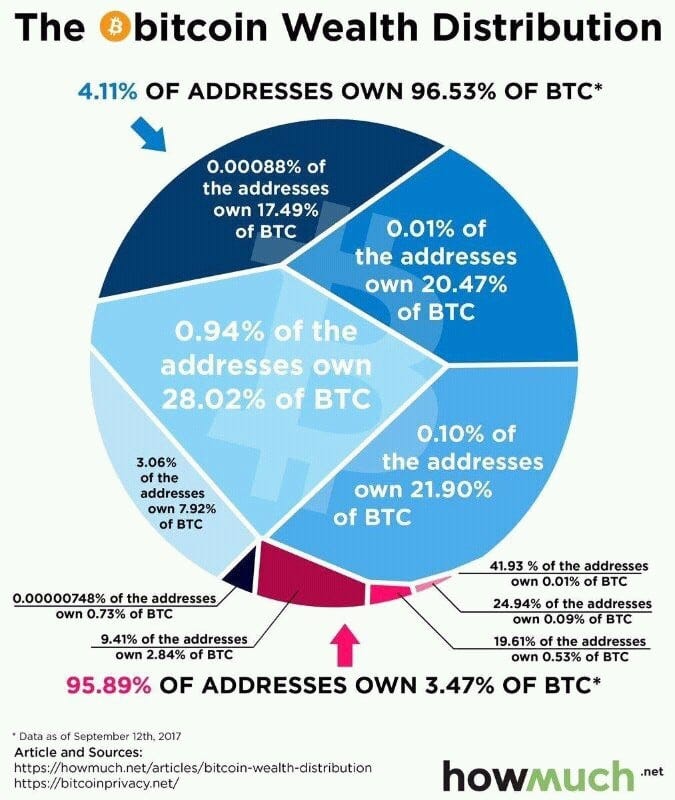
Despite its decentralized infrastructure, Bitcoin ownership is highly concentrated:
As of recent estimates, about 2% of addresses hold over 95% of all Bitcoin in existence.
The top 1,000 addresses control more than 40% of the total supply.
Satoshi Nakamoto alone is believed to hold over 1 million BTC, untouched since 2010.
This mirrors patterns seen in traditional cartels: a small group controls a resource and influences its narrative, access, and liquidity. The difference is that Bitcoin’s “cartel” is distributed through pseudonymous wallets rather than governments or corporations.
4. Drug Cartels - Medellín Cartel
On the far end of the ethical spectrum lies the Medellín Cartel, the infamous cocaine empire led by Pablo Escobar in the 1980s. While illegal and violently oppressive, the cartel mirrored many dynamics seen in legal cartels. It controlled every stage of cocaine production, from coca farms in South America to international smuggling routes and monopolized distribution across the U.S. and Europe.
At its height, it controlled up to 90% of the global cocaine trade. Escobar used both terror and populist strategies to maintain power, building infrastructure for the poor to cultivate loyalty while brutally eliminating rivals and dissent.
The cartel enforced scarcity and shaped demand just as deliberately as any corporate monopoly. Its collapse came from a mix of state intervention, inter-cartel conflict, and the death of its central figure, but its organizational model has influenced criminal enterprises ever since.
Conclusion on Cartels
Whether legal (like OPEC), corporate (like De Beers), digital (like Bitcoin), or illegal (like Medellín), the anatomy of cartels shares a consistent playbook:
Control supply
Manufacture legitimacy
Engineer demand
Suppress competitors
Protect wealth concentration
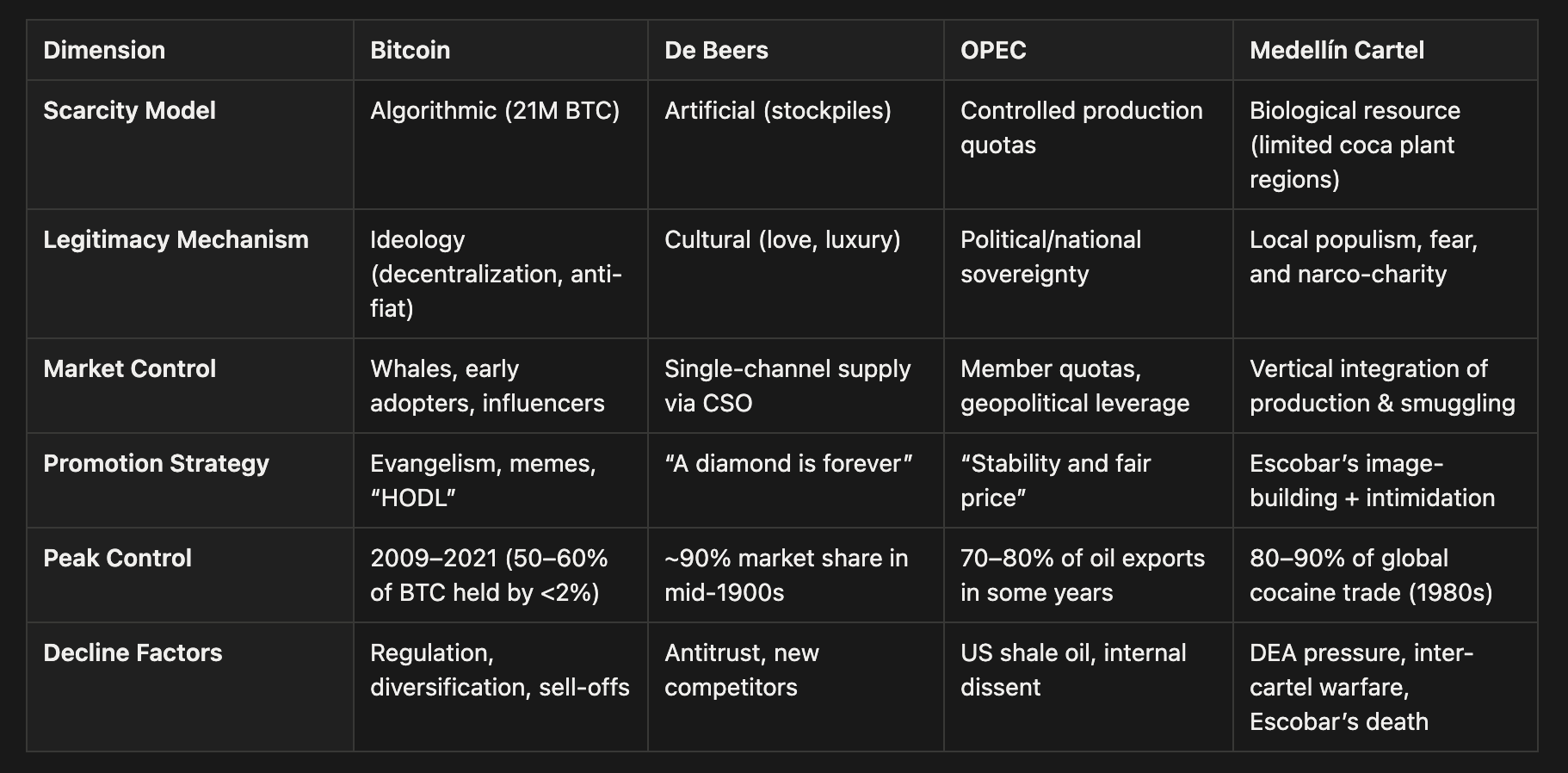
Despite vast differences in legality and intent, Bitcoin, De Beers, OPEC, and the Medellín Cartel all illustrate how power consolidates around control of scarce resources.
Whether through code, culture, policy, or coercion, each system cultivated demand, enforced scarcity, built narratives to legitimize their dominance, and resisted competition until internal or external pressures forced evolution or collapse.
In studying these systems side-by-side, we gain a deeper understanding of how markets licit or illicit are shaped not only by economics, but by ideology, storytelling, and power.
Explanation of Supply and Demand Curves and Cartel Influence
Now that we’ve established our understanding of cartels, we try to better understand how their influence can be used to create wealth. So here’s a small lesson on Economics 101. Demand and Supply Curves.
In a typical free market, the supply curve slopes upward (producers supply more at higher prices), and the demand curve slopes downward (consumers buy more at lower prices). The point where these two curves intersect is called the market equilibrium, which determines the natural price and quantity of a good.
However, cartels disrupt this balance by intentionally restricting supply to influence prices. When a cartel like OPEC, De Beers, or even the Medellín Cartel restricts the quantity of oil, diamonds, or cocaine (respectively) entering the market, they cause the supply curve to shift leftward, meaning less product is available at every price level.
This shift leads to a higher market price and a lower quantity sold, effectively inflating the value of the resource. Cartels profit by selling fewer units at much higher margins, and by engineering scarcity, they also protect their dominance by making it harder for competitors to enter the market.
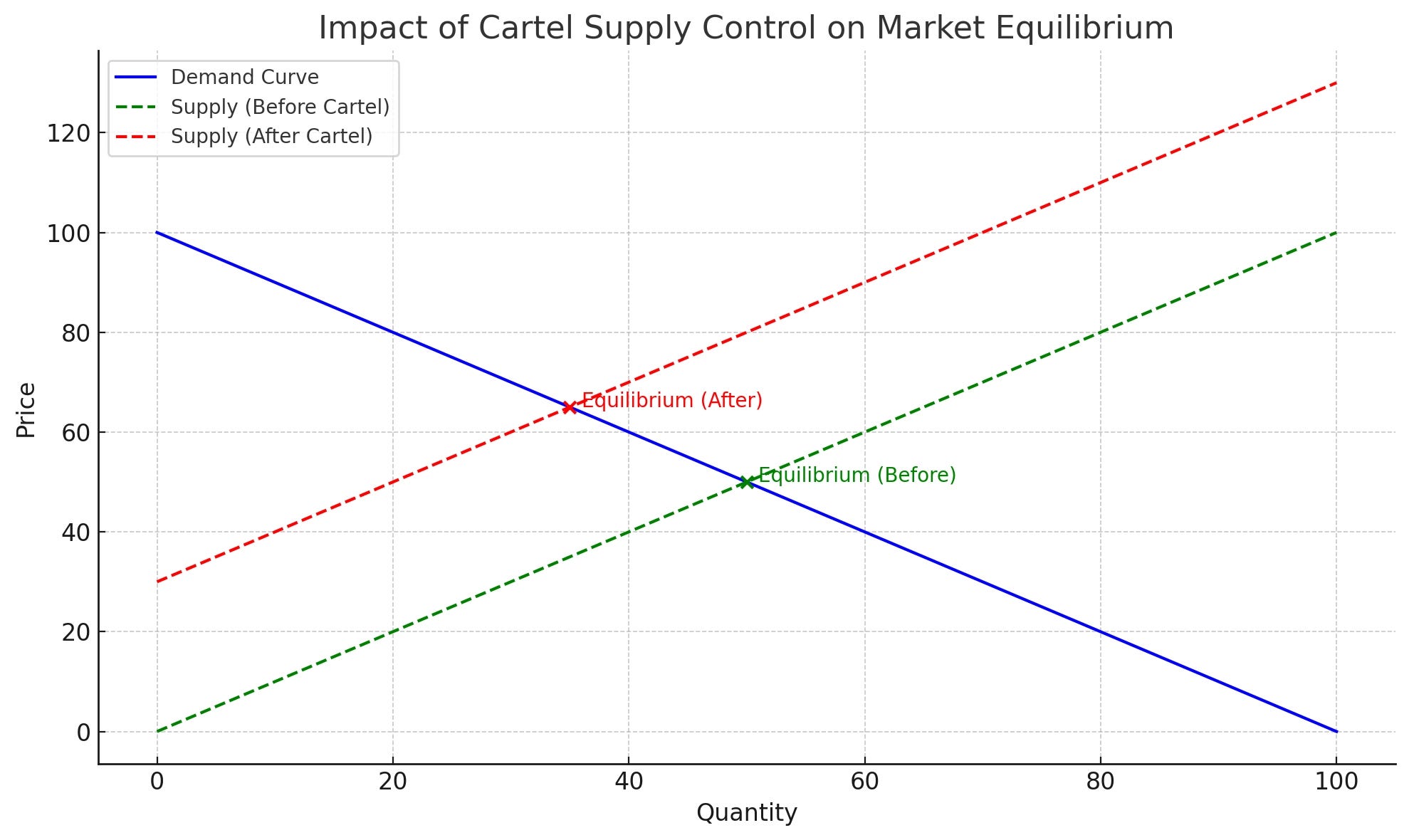
The chart above illustrates this:
The green dashed line is the original supply before the cartel leading to a reasonable equilibrium.
The red dashed line represents the supply after cartel intervention drastically reducing available quantity.
The red dot shows how equilibrium shifts: higher prices and reduced supply, which is ideal for cartel profit-maximization.
This mechanism is central to how cartels operate across domains from decentralized crypto communities to state-run oil alliances create and sustain outsized economic gains through supply control.
Game Theory of Cartels
And lastly now to piece it all together is Game Theory.
Much like a game of chess, cartels also follow a game theory model. At its core, a cartel is a coordination game among rational actors who have incentives to cooperate for mutual benefit, but also strong temptations to defect for individual gain.
The decision to form a cartel resembles a cooperative game:
Firms or states come together to collude on setting prices or controlling output.
The collective benefit (e.g. higher prices, increased market power) outweighs what each player could earn in perfect competition.
The challenge is to sustain the agreement since each member could benefit more (in the short term) by secretly cheating on the deal (e.g. overproducing and undercutting others).
Understanding the Prisoner’s Dilemma
The Prisoner’s Dilemma is one of the most famous concepts in game theory, used to illustrate the conflict between individual rationality and collective benefit. It shows how two rational individuals might not cooperate even if it’s in their best interest to do so because they lack trust or communication.
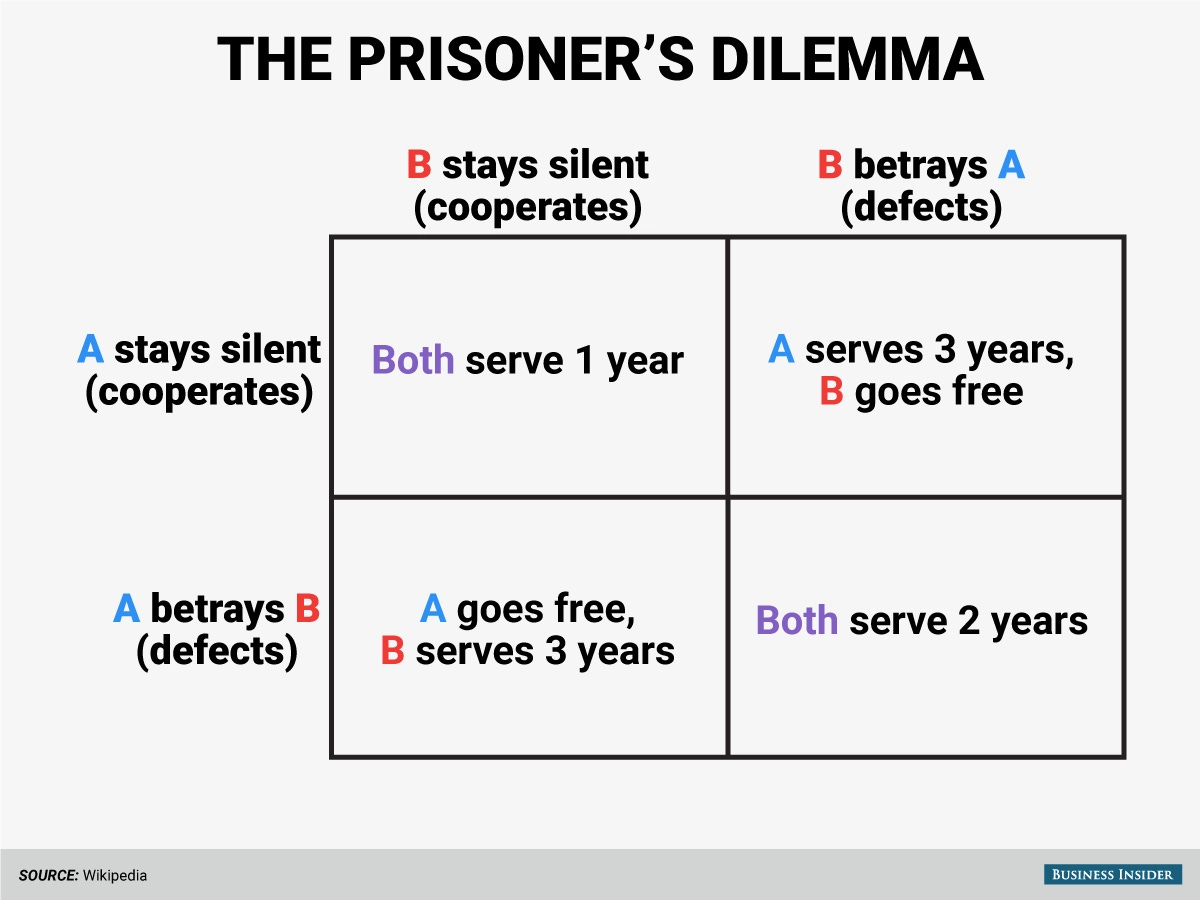
Imagine two suspects are arrested for a crime. They are isolated from each other and given the following options by prosecutors:
If both stay silent (cooperate): Each gets 1 year in prison.
If one betrays the other (defects) while the other stays silent: The defector goes free, and the silent one gets 5 years.
If both betray (defect) each other: Both get 3 years.
The rational strategy for each individual, assuming they want to minimize jail time is to defect. But if both defect, they end up worse off than if they had cooperated. This reveals a paradox: Rational self-interest leads to a collectively worse outcome.
In cartel dynamics:
Cooperation = Stick to agreed output or prices.
Defection = Cheat by overproducing or undercutting prices.
Each member benefits most by defecting if others cooperate but if all defect, the cartel collapses, and everyone earns less. This is exactly the Prisoner’s Dilemma in action.
The Prisoner’s Dilemma illustrates why trust, enforcement, and repeated interactions are crucial in strategic cooperation.
The Taboo of Engineered Wealth
Despite the clarity and truth behind how wealth is engineered through scarcity manipulation, narrative control, and coordinated economic behavior this kind of knowledge remains largely taboo, rarely taught, and often actively discouraged from open discussion. Why?
Because pulling back the curtain on wealth creation threatens the legitimacy of those who benefit most from the illusion of fairness.
In most societies, wealth is officially understood as the result of merit: hard work, innovation, entrepreneurship, or talent. That story is useful it creates social order, motivates participation in the economy, and preserves institutional trust.
But the truth is far less romantic. Much of the world’s wealth is not earned linearly, but instead compounded through advantage, coordination, insider access, and asset control. When you reveal that:
OPEC manipulates oil markets like a monopoly,
De Beers manufactured diamond scarcity for emotional leverage,
Early Bitcoin adopters locked in asymmetric wealth while promoting decentralization and so on…
You begin to show that the rules of the game are different depending on where you sit on the board. Ironically, cartel-like behavior is rampant in the so-called legitimate world, just hidden under different names:
Lobbying is cartel influence over lawmaking.
Central banks coordinate interest rates like a financial OPEC.
IP monopolies (pharma, tech) restrict supply for outsized profits.
Luxury branding mimics De Beers by selling narrative over material.
These are all legal, respectable even celebrated forms of economic control. But they’re no less manipulative than Escobar’s cocaine empire or the early meme lords of crypto. The difference lies in who benefits and who gets to write the rules.
Cartel-style thinking scarcity, coordination, narrative is not fringe. It is mainstream power in camouflage. But the societal fabric relies on the belief that wealth comes from virtue, not manipulation. That’s why this truth stays underground, coded in irony, memes, or academic papers that only a few read.
To speak openly about it is to risk reputation, challenge the status quo, and make visible what many powerful actors would prefer remain hidden.
Final Thoughts
Across our entire exploration from oil and diamonds to crypto and cocaine a clear and provocative insight emerges: wealth is rarely found, and almost always engineered.
Whether it’s OPEC manipulating oil supply, De Beers turning ordinary carbon into luxury through advertising, or early Bitcoin adopters framing code into ideology, the pattern is consistent: strategic control of a scarce asset, coupled with powerful narrative and coordinated behavior, creates asymmetrical economic outcomes.
These systems, while wildly different in legality, morality, and transparency, share a common toolkit:
Scarcity is a story: whether natural, artificial, or memetic.
Control is power: whether through statehood, cartel enforcement, or insider tokenomics.
Trust and belief fuel value: whether in gold, God, or Dogecoin.
Wealth doesn’t just flow to innovation, it flows to those who can orchestrate value perception, influence distribution, and align incentives over time. That’s why the game theory behind cartels, the supply-demand dynamics they distort, and the mimetic forces they tap into are so powerful.
In the end, understanding how wealth is created by design, not accident equips us with the insight to either build our own systems, resist exploitative ones, or simply see the game for what it is.
Oooooo this is GOOOD